
Why ITLC Still Matters In Radiochemical Purity Testing
Mar 31st 2026
In an era of advanced analytical technologies, it’s natural to assume that older methods would be replaced.
So why hasn’t Instant Thin Layer Chromatography (ITLC) been outdated by HPLC in radiochemical purity (RCP) testing?
HPLC is more advanced, offers higher resolution, and provides detailed impurity profiling.
But the real answer lies in one critical limitation—free isotope detection.
The Core Challenge in Radiopharmaceutical QC
Radiopharmaceuticals are fundamentally different from traditional pharmaceuticals:
- They exist at trace mass levels
- Many involve short-lived isotopes
- Even minor surface interactions can significantly impact results
One of the most critical QC parameters is the accurate measurement of free isotopes or free radiometals.
Where HPLC Falls Short
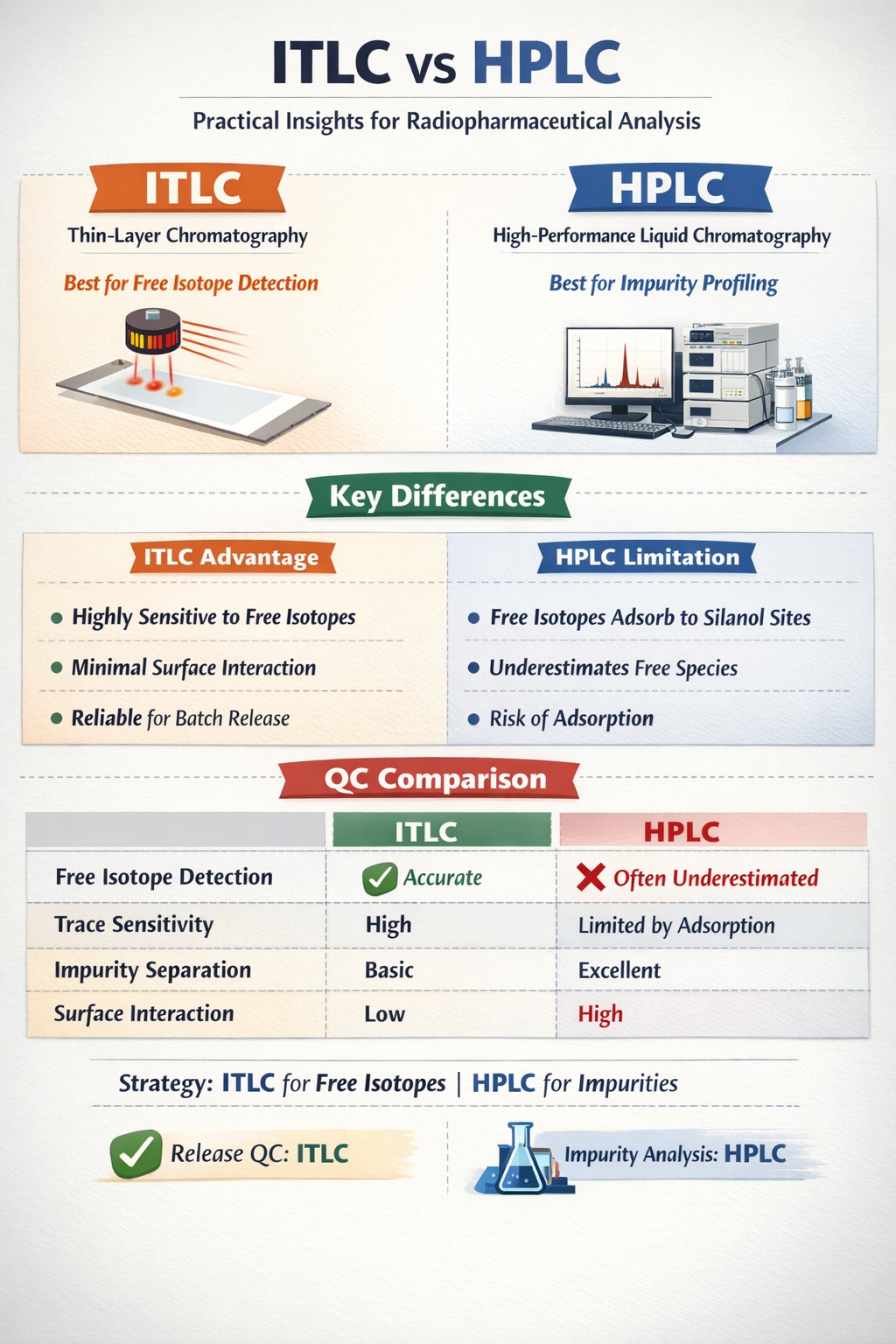
HPLC is highly effective for impurity profiling and molecular characterization. However, it has a well-recognized limitation when it comes to detecting free isotopes.
Most HPLC columns contain silica-based stationary phases with residual (uncapped) silanol (Si–OH) groups. These sites can interact with charged species:
- Metal cations (radiometals) may bind strongly
- Anions (e.g., F-18⁻) may also exhibit adsorption
Impact on Results
These interactions can lead to:
- Adsorption of free isotopes onto the column
- Reduced recovery
- Underestimation of free isotope content
In practice, this means HPLC may report a higher radiochemical purity than actually present.
Why ITLC Remains Essential
Despite being a simpler technique, ITLC continues to play a critical role in radiopharmaceutical QC.
1. Minimal Surface Interaction
Shorter interaction time reduces adsorption effects and improves accuracy for free isotopes.
2. Higher Sensitivity at Trace Levels
ITLC allows extended scanning of the strip, making it highly sensitive for detecting very small amounts of free isotope.
3. Speed for Time-Critical Applications
Results are available in minutes—critical for short half-life isotopes.
4. Robust and Reliable
Simpler systems reduce variability, contamination risk, and system-related artifacts.
ITLC vs HPLC: Complementary Roles
Rather than competing methods, ITLC and HPLC serve different purposes:
- ITLC → Free isotope detection and routine release QC
- HPLC → Impurity profiling and detailed characterization
The most effective QC strategy uses both.
Industry Insight
Many radiopharmacy labs have observed that while HPLC is theoretically superior, it can be less reliable for detecting free isotopes due to adsorption effects.
As a result, ITLC remains the preferred method for release QC across many workflows.
Conclusion
ITLC has not remained in use because it is simple or inexpensive.
It has endured because it delivers reliable, accurate results where it matters most—free isotope detection at trace levels.
In modern radiopharmaceutical QC, success is not about choosing one method over another, but understanding how to use each effectively.
About Molpure
At Molpure, we focus on developing ITLC products with the lowest possible variability—ensuring consistent and reliable radiochemical purity results.
Our goal is to support radiopharmacies with tools that perform under real-world conditions, where precision at trace levels is critical.